Article
After the September 2025 Aljezur fire, UK and Irish hikers planning Algarve summer trips need a practical safety brief. Here's how locals read the IPMA daily risk map, which trails we avoid in high-risk windows, and the coastal alternatives that stay open all summer.
Why This Guide Exists
In September 2025 a wildfire near Aljezur on the western Algarve spread at roughly 600 hectares per hour at its peak. UK papers covered it. The footage of cork oak and pine forests burning is still doing the rounds on social media. If you're flying in for summer 2026 with hiking plans, you have a fair question: is it safe?
The honest answer is: yes, but you need to read the daily risk map and pick your routes accordingly. Locals do this every morning between May and October. Here's how.
The Calendar
Portuguese fire season officially runs 1 July to 30 September, but in practice the Algarve interior is fire-vulnerable any dry, windy day from late May through to first sustained autumn rain (often mid-October, sometimes November). The west coast and Serra de Monchique are the highest-risk zones. The coastal cliff trails are largely safe — there is nothing flammable on the cliff face.
If you're hiking in:
- April–early May: Negligible fire risk. Hike anything.
- Mid-May to late June: Low risk most days. Check IPMA on hot/windy days.
- July–September: Active fire season. Daily IPMA check is non-negotiable.
- October–November: Risk drops after the first sustained rain; before that, treat as fire season.
The One Tool You Need: IPMA

The Instituto Português do Mar e da Atmosfera (IPMA) publishes a Rural Fire Danger Index every day at ipma.pt. The map has five colour levels: Reduced (green) / Moderate (yellow) / High (orange) / Very High (red) / Maximum (dark red).
Read it like a weather forecast for fire. Conditions can shift from yellow to red in 36 hours when an Atlantic warm front hits. We check it the night before every interior hike from June through October.
Practical thresholds:
- Green / Yellow: Hike anywhere, normal precautions.
- Orange (High): Avoid interior trails in Monchique, Caldeirão, Aljezur hinterland. Coastal trails fine.
- Red (Very High): Stay on the coast. No interior hiking, no off-trail walking, no camping outside formal sites.
- Dark Red (Maximum): Stay off trails entirely. Many will be closed by GNR. Use the day for a beach + boat trip.
What Changed After the 2025 Aljezur Fire
The September 2025 fire was a wake-up event for everyone in the region. A few practical takeaways for hikers:

- Speeds can jump. That fire moved under 2 km/h on its first day, then 600 ha/hour. Wind shifts in seconds.
- Local closures happen. GNR closes specific roads and trail entrances when risk spikes. Signs in Portuguese first, English sometimes. Respect tape and cones — they're not advisory.
- Authorities now publish active-incident maps. Civil protection (
prociv.pt) shows live fire locations during incidents. Bookmark it alongside ipma.pt. - Aljezur municipality has updated trail markers along PR1 and PR4 with refuge points (water source, parking area, marked retreat directions). Look for the orange triangle.
Coastal Routes — The All-Summer Safe Bets
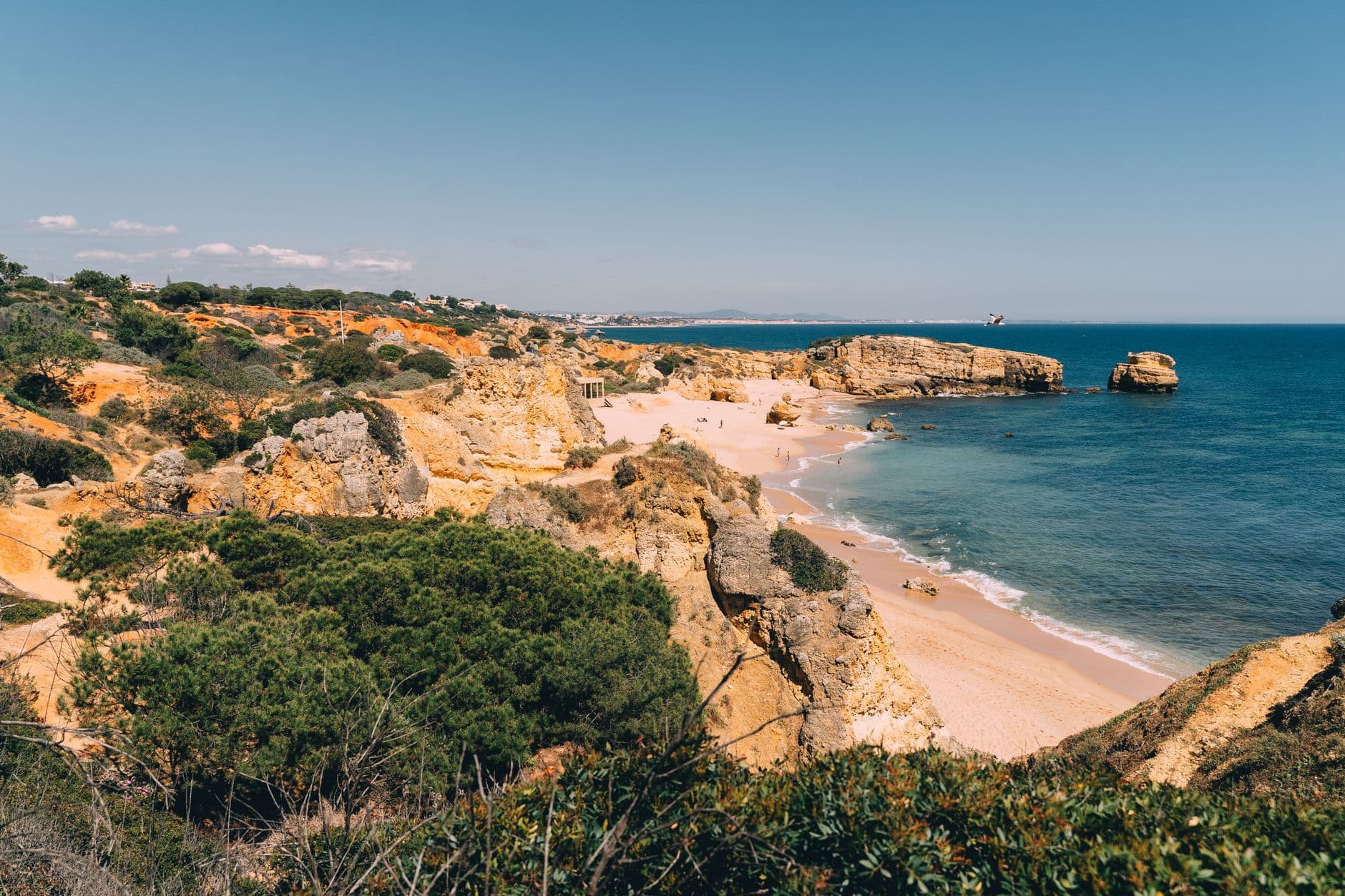
These coastal trails stay safe in fire season because there is no flammable vegetation on the cliff face. Even in dark-red weeks, you can hike these:
- Seven Hanging Valleys (PR1 LGA): Carvoeiro to Praia da Marinha. Spectacular and almost always open. See our full guide.
- Fishermen's Trail (Rota Vicentina coastal stretch): The single-day Aljezur to Arrifana section is coastal cliff-edge — even in fire season the interior risk doesn't affect it directly. But avoid days when wind is blowing offshore from the interior — smoke crosses the path.
- Ria Formosa boardwalks: Olhão / Faro / Tavira marshland walks are coastal, low fuel load, almost zero fire risk.
- Praia da Luz to Burgau cliff path: Easy 5km out-and-back along open cliff.
For the broader picks see Best Hikes in the Algarve.
Interior Routes — Use the Calendar

The interior is the most rewarding hiking in the Algarve in winter and spring, and a serious risk in summer. Save these for shoulder season:
- Via Algarviana (300km cross-Algarve trail) — sections through cork oak and pine country. Beautiful November–April, restricted by IPMA from July.
- Fóia and Picota (Monchique) — high points of the Algarve. Stunning, but in the heart of the 2025 fire region. Off-limits on any high-risk day.
- Caldeirão range — schist villages and quiet valleys. Hike October–May.
- Cork oak forests around Loulé and São Brás — pretty in spring, no-go in August.
The Kit That Actually Matters in Summer
- Mobile phone with Portuguese SIM or roaming confirmed. Emergency number is 112. Tell them in English; operators in fire season have it covered.
- 2L water per person minimum for any walk over 8km, regardless of how cool the morning feels.
- A whistle. Lighter than a phone call, works when you're in shock.
- Offline maps downloaded. Komoot, AllTrails, or Gaia. Don't rely on signal.
- Long trousers for serious bush walking — yes, even in heat. Brambles, ticks, and snake protection.
- No cigarettes, no fires, no glass bottles anywhere outside formal sites. This is the single biggest cause of human-started fires in the region.
What to Do If You See Fire
- Move perpendicular to the wind, downhill if possible. Fire moves uphill fastest.
- Call 112 immediately with your location. GPS coordinates from your offline map if you can.
- Do not drive towards the fire to film or photograph. This is what gets civilians killed in Portuguese fires.
- Once safe, stay informed. Listen for evacuation orders if you're near a populated area.
Practical Booking Advice
If your trip is in July or August 2026 and hiking is the point, consider:
- Booking accommodation on the coast or in Tavira so coastal hikes are walkable from base.
- Renting a car so you can pivot if interior trails close — never plan for one trail only.
- Hiking guided with a local guide who knows the closures and alternates in real time.
- Considering June or late September instead — the risk window narrows dramatically and the trails are quieter.
For the trails themselves, see our best hikes guide, the Seven Hanging Valleys deep-dive, and the broader hiking trails guide.
Last updated: May 2026. Fire-season status checked daily by IPMA at https://www.ipma.pt/en/riscoincendio/rcm.pt/.
Experience It Yourself
Book a guided experience in the Algarve
Bike Ride to Castle of Aljezur Portugal Tour
From €90
Twister Private Water Tubing in the Algarve
From €15
Twister Ride, Algarve, Portugal
From €15
About the Author
Active Algarve Team
7 min read
Sharing the best of the Algarve with our readers.
Get the Algarve Insider
Hidden trails, local events, and experiences worth booking.
No spam. Unsubscribe anytime.
Related Guides
Discover more of the Algarve
Algarve Package Holidays 2026: What UK Travellers Actually Pay
Comparing real Algarve package holidays for 2026: flight and hotel combinations from £79 to £349 per person, breaking down what suits each type of UK traveller.